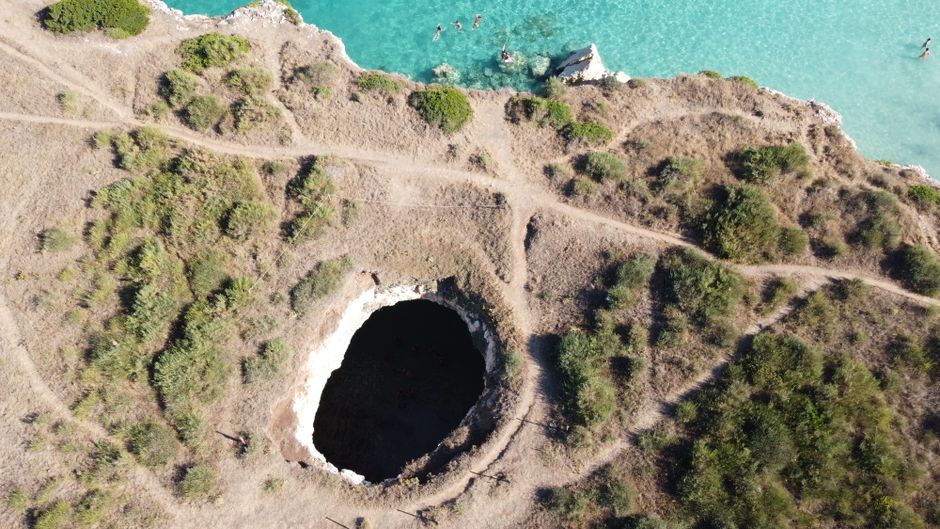
There is an unlikely geological bond between a quiet corner of County Monaghan and one of the most famous cities in the world. Magheracloone, a small rural area outside Carrickmacross, shares a curious link with the Montparnasse district of Paris, and it all comes down to what lies beneath the ground.
Magheracloone is home to the only known deposits of gypsum on the island of Ireland. That alone makes it geologically unique, but what makes the story more interesting is what gypsum does to the land above it, and how that same problem has haunted Paris for centuries.
Gypsum is a soft sulphate mineral that dissolves relatively easily in water. When groundwater works its way through gypsum deposits over long periods of time, it hollows out cavities underground. Those cavities can grow quietly for years, completely invisible from the surface, until the ground above them simply gives way. The result is a sinkhole, sudden, dramatic, and potentially dangerous.
In Magheracloone, this is not just a theoretical risk. The area has experienced real sinkhole activity over the years, with the ground opening up and swallowing everything above it. Fields, roads, and structures have all been affected. It is the kind of thing that sounds almost cartoonish until it happens on your doorstep.
Paris has its own long and complicated relationship with what lies underground. The French capital sits on top of a vast network of tunnels and quarries, many of which were carved out over hundreds of years to extract limestone used in constructing the city above. The famous Catacombs are part of this network. But Paris also has gypsum in its geology, and that gypsum was mined extensively to produce what became known globally as plaster of Paris. The name is not a marketing invention. It came directly from the fact that the material was produced from Parisian gypsum deposits, particularly around the Montmartre and Montparnasse areas.
All that underground extraction left Paris sitting on top of a fragile, honeycombed foundation. Collapses and subsidence have been recorded in the city for centuries. Managing the underground has become a serious and ongoing engineering challenge for the French capital, with dedicated teams responsible for inspecting and maintaining the tunnel networks beneath the streets.
Back in Monaghan, the gypsum at Magheracloone has been quarried commercially. The material is used in construction, particularly in the production of plasterboard, which is a staple of modern building. So while the Paris connection is geological and historical, there is also a practical, industrial thread running through both stories. Gypsum has built cities and, in its dissolving, has also threatened to swallow parts of them.
The sinkholes in Magheracloone have prompted ongoing concern among locals and engineers over the years. The area requires careful monitoring because the dissolution of gypsum underground is a slow but relentless process. Water does not stop moving, and cavities do not stop growing just because nobody is watching them.
What makes the Monaghan situation particularly striking is just how rare it is in an Irish context. The rest of the country does not have gypsum geology in any significant way, which means the sinkhole risk that locals in Magheracloone live with is almost entirely unknown to people elsewhere in Ireland. It is a very specific and localised hazard sitting in the middle of an otherwise ordinary rural landscape.
Geologists and engineers who study the area point out that predicting exactly where and when a sinkhole will form is extremely difficult. Ground penetrating radar and other survey techniques can identify voids beneath the surface, but the timing of a collapse depends on too many variables to forecast with precision. The best approach is monitoring, planning restrictions in the most vulnerable areas, and making sure that anyone building or working in the zone understands what they are dealing with.
For most people, the word sinkhole conjures images of Florida or Central America, places where dramatic collapses are caught on video and shared widely online. The idea that a small townland in County Monaghan shares the same fundamental geological hazard as the streets of Paris is the kind of fact that makes you look at the Irish countryside slightly differently.
Under the green fields of Magheracloone, the water keeps moving, the gypsum keeps dissolving, and the ground keeps its secrets, at least until it decides not to.