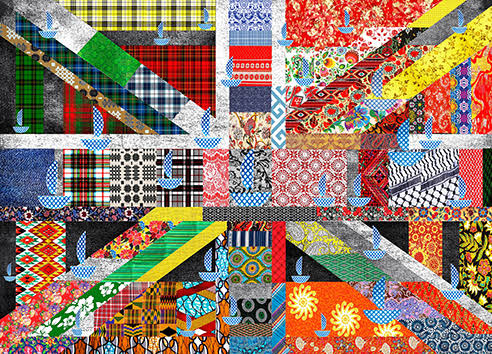
A British artist set out to redesign the Union Jack as a statement against racism, and what followed was the kind of story that writes itself. The redesigned flag, pitched as an “anti-racist” alternative to the traditional Union Jack, managed to upset pretty much everyone it was meant to please, sparking a debate that spread rapidly across social media and beyond.
The artist behind the project wanted to challenge what they described as the flag’s association with far-right groups and nationalist movements, arguing that the Union Jack had been co-opted by people with racist views. The redesign aimed to create something more inclusive, stripping back or altering the traditional red, white and blue design to better represent modern Britain.
But rather than being welcomed with open arms by progressive communities, the redesign was met with fierce criticism from across the political spectrum. Left-leaning commentators argued the project was patronising and missed the point entirely, while others felt that redesigning a national symbol solved nothing practical. Conservative voices, predictably, were even less impressed.
The backlash highlighted a growing tension within progressive spaces in England, where well-intentioned gestures frequently spark internal disagreements about what actually constitutes meaningful action. Critics pointed out that changing the aesthetics of a flag does nothing to address real issues like institutional racism, housing inequality, or discrimination in the workplace.
Some commentators online were quick to note the irony of an anti-racism project becoming a flashpoint for division rather than unity. The debate quickly moved away from the flag itself and into broader questions about symbolism versus substance, and whether artistic gestures can carry genuine political weight.
The Union Jack has long been a contested symbol in England. For many people it represents national pride, sporting events, and a shared identity. For others, particularly in recent years, it has become uncomfortably linked to far-right groups who have used it prominently at rallies and protests. That tension is real, and the artist was tapping into something genuine.
However, the execution left a lot of people cold. Rather than opening up a productive conversation, the redesign became a lightning rod for mockery and frustration. Social media users shared the image widely, though not always in the spirit it was intended. Memes followed quickly, as they always do.
Design experts also weighed in, with some arguing that the revised flag lacked the visual clarity and historical weight of the original. The Union Jack is one of the most recognisable flags in the world, built from the crosses of Saint George, Saint Andrew, and Saint Patrick. Unpicking that is not just a political act but a significant design challenge, and many felt the result did not land.
What the whole episode really exposed is how difficult it is to use symbolic gestures to address deeply rooted social problems. England has genuine and ongoing conversations to have about race, identity, and belonging. Those conversations matter. But they tend to get derailed when the focus shifts to objects and symbols rather than policy, lived experience, and structural change.
The artist has stood by the project, arguing that provoking debate was part of the intention all along. If that was the goal, it certainly worked. Whether the debate that followed was the one they hoped for is another question entirely.
For now, the Union Jack remains unchanged, flying above public buildings and waved at football matches just as it always has. The redesign exists online, generating clicks and arguments in equal measure. England carries on.