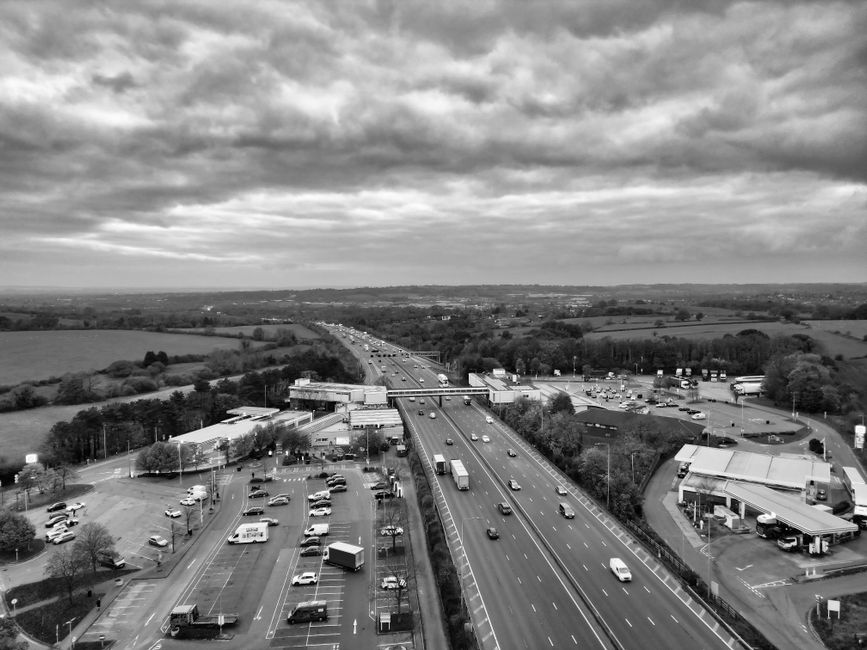
Plans being considered by the Welsh Government to close certain M4 junctions around Newport might ease congestion on the motorway itself, but critics are warning it could simply dump the problem onto already-busy local streets.
The proposal, which is still at the consideration stage, would see junctions around Newport restricted or closed entirely as a way to reduce bottlenecks and cut pollution along one of Wales’s most congested stretches of road. On paper, fewer entry and exit points means smoother motorway flow. In practice, though, transport experts and local voices are raising serious concerns about what happens next.
The core issue is straightforward. If drivers can no longer use certain junctions to join or leave the M4, they still need to get where they’re going. That traffic does not disappear. It reroutes. And in Newport’s case, that means it ends up on city roads that were never designed to handle that kind of volume.
Newport already deals with significant traffic pressure. The city sits at a key point along the M4 corridor, acting as a gateway between South Wales and the border with England. Commuters, freight lorries, and long-distance drivers all funnel through the area daily. Adding displaced motorway traffic into that mix could push local junctions and residential routes well beyond their limits during peak hours.
There is also the pollution angle, which is arguably just as important as the congestion question. One of the stated goals behind reviewing the junctions is to reduce harmful emissions along the motorway. But closing junctions and forcing vehicles onto slower, stop-start city roads could actually increase emissions in residential areas. Engines stuck in urban traffic jams produce more pollution per mile than vehicles moving steadily on a motorway. So while air quality figures on the M4 itself might improve, the people living in Newport’s streets could end up breathing worse air than before.
This is not a new tension in transport planning. Wales has been wrestling with the M4 question for years. The most high-profile chapter was the long-running debate over a relief road south of Newport, a major infrastructure project that was eventually scrapped by the Welsh Government in 2019 on environmental and cost grounds. That decision left the underlying congestion problem unresolved, and policymakers have been looking at alternative solutions ever since.
Junction closures represent a lower-cost, lower-disruption option compared to building new roads. But lower cost does not automatically mean better outcomes, and the risk of simply relocating the problem rather than solving it is real.
Transport campaigners have pointed out that any junction changes need to come alongside genuine investment in alternatives. Better bus services, improved cycling infrastructure, and reliable rail connections into Newport city centre are all part of what would need to happen for reduced motorway access to work without hammering local roads. Without that joined-up approach, drivers who can no longer use their usual junction will not suddenly switch to public transport. They will just take a different road.
The Welsh Government has not yet confirmed any firm plans, and consultation with local authorities and communities would be expected before any changes were made. Newport City Council would have a significant stake in those conversations, given that its road network would bear the brunt of any displaced traffic.
For Newport residents, the concern is that decisions made at a motorway planning level end up playing out on their doorsteps. Rat-running through residential streets, longer journey times for people trying to get across the city, and dirtier air in neighbourhoods close to rerouted traffic are all potential consequences that will need serious answers before any junction closures go ahead.
The Welsh Government’s approach to the M4 corridor will continue to be one of the trickier transport challenges it faces. The road is too important to ignore and too embedded in the region’s daily life to change without consequences. Getting the balance right means being honest about the trade-offs, and right now, the junction closure idea still has some significant questions hanging over it.