
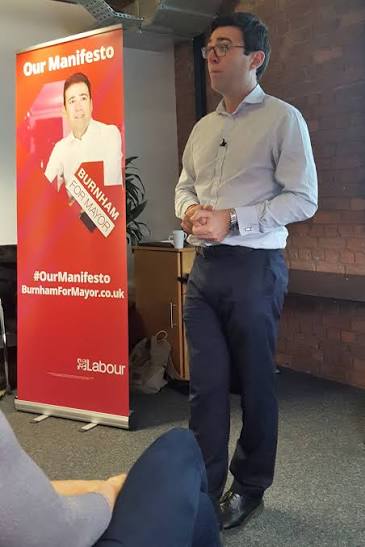
Andy Burnham has never been shy about where he comes from. The son of a telecoms engineer, raised in Culcheth, a small town in Cheshire, Burnham has spent much of his political career reminding Westminster that Britain does not begin and end in the capital. Now, as speculation grows about his broader political ambitions, the question being asked across the north of England and beyond is whether the Mayor of Greater Manchester can translate his powerful rhetoric about hope, dignity and working people into something genuinely transformative.
Burnham’s record in Manchester has given his supporters plenty of ammunition. Since taking office in 2017, he has pushed hard on homelessness, launching the A Bed Every Night scheme that provided emergency shelter for rough sleepers across Greater Manchester during the brutal winter months. He fought publicly and loudly against the government during the Covid pandemic, famously standing outside a press conference in October 2020 to condemn what he called inadequate financial support for the region ahead of tighter restrictions. The image of Burnham at that microphone, defiant and unapologetic, became a defining moment for many who felt that northern communities were being treated as an afterthought by Downing Street.
His push for greater devolution has also won admirers. Burnham has long argued that power concentrated in Westminster is one of the fundamental problems holding back towns and cities outside London. He has championed integrated transport systems, sought greater control over housing policy, and made the case repeatedly that local leaders who understand their communities should be trusted with the tools to improve them. The Bee Network, Greater Manchester’s ambitious project to bring buses back under public control, has been held up as a model for what devolved government can achieve when it is given the freedom to act.
Yet critics argue that the gap between Burnham’s soaring language and the lived reality of many working people in the north remains stubbornly wide. Poverty rates across Greater Manchester remain high. Public transport, despite the progress of the Bee Network, is still a daily frustration for many commuters. Waiting times for NHS services in the region mirror the national crisis. And while Burnham speaks movingly about the communities left behind by decades of deindustrialisation, some argue that the structural forces driving inequality require national solutions that no regional mayor, however determined, can deliver alone.
The debate about Burnham’s future has intensified in recent months. With Labour now in government under Sir Keir Starmer, questions are circulating about whether Burnham might eventually seek a return to frontline national politics. He has been careful not to fuel that speculation directly, insisting his focus remains on Greater Manchester. But those who know him well suggest he has not abandoned his belief that the arguments he has been making from the north deserve a bigger stage.
For working class communities across Britain, the stakes in that debate feel very real. Decades of promises from politicians of all parties have left a deep well of scepticism in towns from Wigan to Wolverhampton, from Sunderland to Swansea. People have heard the language of renewal and investment before. They have watched factories close, high streets hollow out, and young people leave in search of opportunities that their home towns could not provide. What they are looking for now is not another politician who speaks their language but one who can actually change the material conditions of their lives.
Burnham’s genuine connection to working class experience is not in doubt. Unlike many senior politicians who claim solidarity with ordinary people from a considerable distance, Burnham’s background and his career choices suggest something more authentic. He turned down opportunities that might have taken him further and faster up the Westminster ladder because he chose to fight for a region that he believed in. That counts for something, particularly at a time when trust in political institutions is at a low ebb.
But authenticity alone is not enough. The test for Burnham, whether he remains in Manchester or eventually seeks a larger role, is whether he can build the coalitions, secure the resources and drive through the reforms that would give working people not just a sense that someone is speaking for them, but concrete improvements in their daily lives. Better buses and trains. More affordable housing. Local jobs that pay decent wages. Schools and hospitals that work.
The foundation is there. The record in Greater Manchester, while imperfect, shows what focused and determined regional leadership can begin to achieve. The instinct to stand up for places and people overlooked by the traditional centres of power is genuine and consistent. But foundations, however solid, are only the beginning. What working Britain needs now is not just words about hope and dignity. It needs the bricks and mortar of lasting change built carefully on top of them. Whether Andy Burnham is the person to do that, and whether he will have the platform and the power to try, remains one of the most interesting questions in British politics today.

Burnham talks a good game but lets be honest, every politician says theyre for the working class until they’re actually in power. That said, he does seem more genuine than most. The devolution stuff in Manchester has been interesting to watch. cautiously optimistic but not holding my breath.