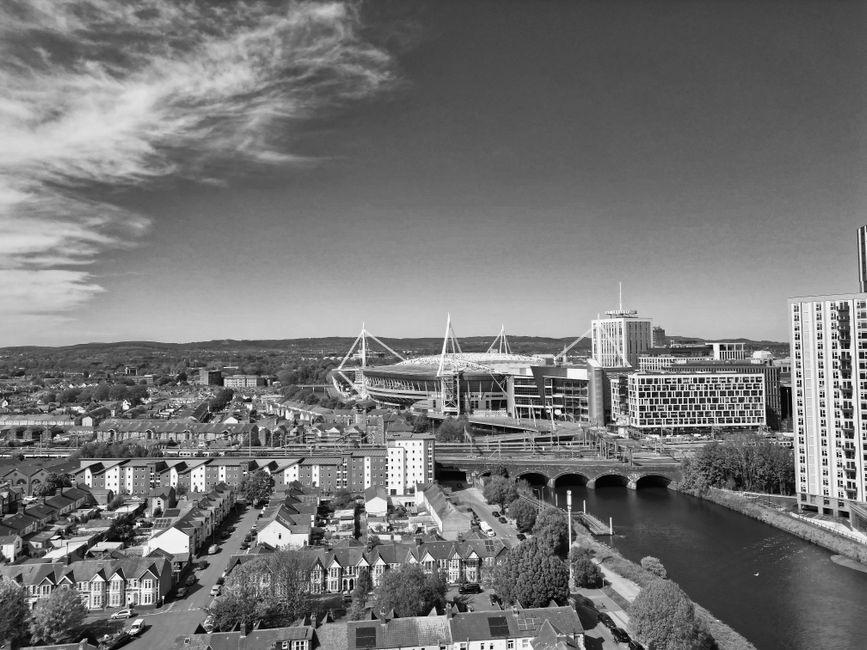
Cardiff has always been a city of contradictions. A place where old docklands sit next to gleaming new developments, where communities have been built and broken and rebuilt again over generations. Now a new short story collection is trying to capture all of that complexity in one book, and by most accounts it is pulling it off.
The Book of Cardiff brings together some of the most important voices in Welsh writing, mixing established names with newer talent to create something that feels genuinely representative of the city. It is the kind of anthology that does not try to present a postcard version of Cardiff, but instead digs into the streets, the people, and the stories that rarely make it into tourist brochures.
The collection draws on the work of writers like Leonora Brito and the late Dannie Abse, both of whom spent years documenting Welsh life with an honesty that could be uncomfortable at times. Brito in particular has long written about the Cardiff docklands community, exploring race, identity, and belonging in ways that still feel urgent today. Abse, who died in 2014, was one of Wales most celebrated poets and writers, and his presence in the collection gives it a sense of literary weight.
But what makes this anthology interesting is how it places those established voices alongside writers like Hanan Issa, who represents a newer generation of Cardiff storytellers. Issa, who was named Wales national poet in 2021, brings a perspective shaped by the modern city, one that is more diverse and more complicated than the Cardiff of previous decades. The combination works because the city itself has always been in a state of change, and the writing reflects that.
Short story collections about specific cities can sometimes feel like a gimmick, a way of packaging local writing for a niche audience without much thought about whether the stories actually hold together. The Book of Cardiff avoids that trap because the city itself becomes a character rather than just a backdrop. Readers who know Cardiff will recognise the streets and the rhythms of the place. Readers who do not will come away feeling like they have actually spent time there.
Cardiff is often overlooked in conversations about British cities with strong literary traditions. London dominates, as it always does, and even cities like Manchester and Liverpool tend to get more attention when it comes to urban storytelling. But Cardiff has a rich and complicated history that gives writers plenty to work with. The coal boom that made the city wealthy, the Tiger Bay community that became one of the most diverse places in Britain long before diversity was a buzzword, the devolution era that gave Wales a new political identity, all of that is woven into the fabric of the city and into the stories collected here.
The anthology does not shy away from the harder parts of that history either. Cardiff has its share of poverty, inequality, and tension, and the best stories in the collection deal with those realities head on rather than smoothing them over. That is what separates good city writing from the kind of nostalgic fluff that tends to dominate local interest publishing.
For anyone who wants to understand Cardiff beyond the Principality Stadium and the Bay development, The Book of Cardiff is a solid place to start. It will not give you a simple or comfortable picture of the place, but it will give you an honest one. And in a city as layered as Cardiff, that is probably the best you can ask for.