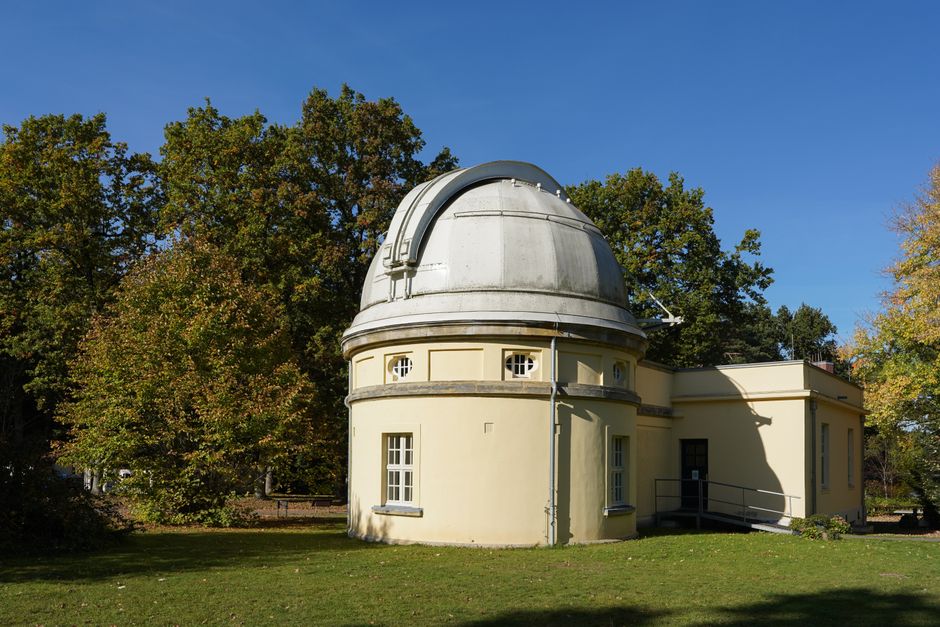
Three of Ireland’s most storied astronomical sites are joining forces in a landmark push to secure UNESCO World Heritage status, combining centuries of scientific achievement into one ambitious bid.
Dunsink Observatory in Dublin, Birr Castle Observatory in County Offaly, and Armagh Observatory in Northern Ireland have formally united their efforts, hoping that their shared history will be strong enough to earn a place on the prestigious UNESCO list alongside some of the world’s most iconic cultural and scientific sites.
The three sites between them represent a remarkable stretch of Irish scientific history going back hundreds of years. Armagh Observatory was founded in 1790 and has been operating continuously ever since, making it one of the longest-running scientific institutions on the island. Dunsink, located on the outskirts of Dublin, dates back to 1785 and was once home to William Rowan Hamilton, the mathematician who discovered quaternions, a breakthrough that still underpins modern computer graphics and aerospace navigation today. Birr Castle, meanwhile, was home to the Leviathan of Parsonstown, a massive telescope built by the third Earl of Rosse in the 1840s that was the largest in the world for several decades. It was through that telescope that the spiral structure of galaxies was first observed.
The case for UNESCO recognition rests heavily on the idea that these three sites, taken together, tell a uniquely coherent story about Ireland’s contribution to global science at a time when astronomical discovery was reshaping how humanity understood the universe.
Proponents of the bid argue that the sites are not just historically interesting but genuinely significant in the development of modern astronomy and mathematics. The work carried out at all three locations fed directly into scientific conversations happening across Europe and beyond during the 18th and 19th centuries, and the physical infrastructure at each site, including original telescopes, instruments, and buildings, has been carefully preserved.
Birr Castle in particular has done extensive restoration work on the Leviathan telescope, which had fallen into disrepair but was rebuilt in the 1990s and now stands as one of the most striking scientific monuments in the country. Visitors can stand beneath the enormous wooden tube and get a real sense of the engineering ambition involved in its original construction, which was carried out largely by local workers during the years of the Great Famine, a fact that adds a complicated but important layer to its history.
Armagh has maintained its role as an active research institution, which gives the bid an interesting angle. This is not purely about preserving the past but about celebrating a living scientific tradition that has adapted and continued across more than two centuries.
Dunsink, managed by the Dublin Institute for Advanced Studies, has in recent years become an increasingly popular public engagement venue, hosting regular open nights and outreach events that bring amateur stargazers and school groups through its doors. That community connection strengthens the argument that these are not just monuments but active parts of Irish cultural life.
The UNESCO World Heritage process is lengthy and competitive. Ireland currently has two World Heritage Sites, Newgrange and the Skellig Michael island monastery, so adding a third, and a scientific one at that, would be a significant achievement. The combined approach taken by the three observatories is seen as a smart strategy, since individually each site might struggle to meet the threshold of “outstanding universal value” that UNESCO requires, but together they present a much more compelling case.
Support for the bid has been building among historians of science, astronomers, and heritage bodies on both sides of the border. The cross-border element, with Armagh sitting in Northern Ireland and Dunsink and Birr in the Republic, has also been highlighted as a positive aspect of the application, reflecting shared heritage that transcends political boundaries.
There is no set timeline yet for when a formal application will be submitted, but the coming together of the three institutions marks a serious step forward in what could become one of the more distinctive UNESCO bids Ireland has ever made.